November 24, 2026 | From the Desk of Victoria
It’s been a while.
When we last visited in July, the NFL season was still months away, the NBA had just welcomed its newest draft class, and collectors were already placing a premium on players who had yet to play a meaningful professional game.
As for me? A little time away from the desk, a few other projects, and plenty of time observing the markets. I haven’t forgotten about our little experiment.
Back in June, we introduced a concept that continues to fascinate me: Can the movement in sports betting markets provide insight into the future value of sports cards?
Nearly five months later, expectations are finally being challenged by reality.
The Price of Potential
Immediately following the first round of the NBA Draft on June 24, we documented the Rookie of the Year futures market. AJ Dybantsa and Cameron Boozer opened as co-favorites at +280.
Neither had played a regular season NBA game.
Fast forward to November 24, and the market looks considerably different.
| Player | June 24 | November 24 |
|---|---|---|
| Yaxel Lendeborg | +3500 | +120 |
| Darius Acuff Jr. | +550 | +150 |
| AJ Dybantsa | +280 | +1000 |
| Darryn Peterson | +360 | +1200 |
| Cameron Boozer | +280 | +1400 |
| Caleb Wilson | +1000 | +5000 |
The expectations surrounding this rookie class have changed dramatically.
But has the sports card market adjusted accordingly?
What Are We Actually Buying?
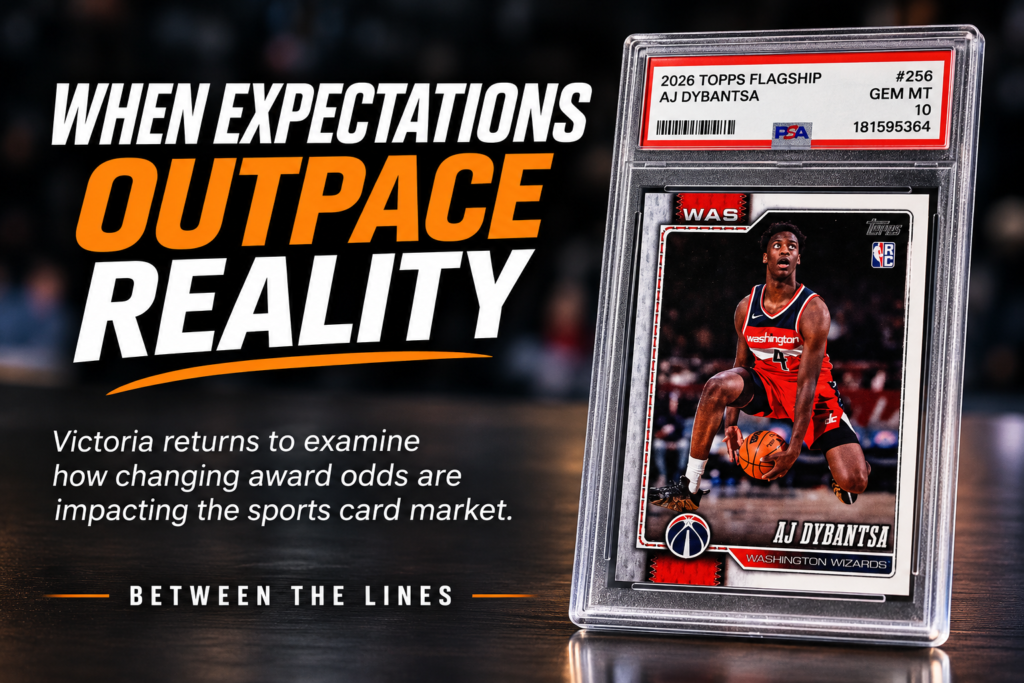
Sitting on my desk this week is an AJ Dybantsa 2026 Topps Flagship PSA 10 rookie card.
In June, his Rookie of the Year odds represented an implied probability of approximately 26.3%. Today, that figure sits at just 9.1%.
That’s a significant adjustment in expectations.
It doesn’t mean Dybantsa has suddenly become a bad basketball player. Nor does it mean he won’t develop into an exceptional NBA talent.
However, it raises an interesting question for collectors.
If the expectations surrounding a player have changed, should the price of his rookie card change with them?
The sports card market operates on a different timeline than the betting market. An oddsmaker can adjust a price overnight. A collector may be reluctant to sell a card for less than what they paid, even when the circumstances surrounding that purchase have changed.
That distinction is worth exploring.
A Changing Market
The excitement surrounding a new product release can create an interesting environment. Limited initial supply, aggressive bidding, prospect speculation and the desire to own a player’s first professional rookie card can all contribute to elevated prices.
Eventually, more cards enter circulation. PSA populations grow. The season progresses, and actual performance begins to replace speculation.
What happens when increasing supply meets declining expectations?
Conversely, what happens to the rookie cards of players like Yaxel Lendeborg, whose award odds have moved from +3500 to +120?
These are precisely the scenarios we hoped to examine when we introduced the Ultra Market Index earlier this year.
Moving forward, we’ll be monitoring completed transactions, grading populations, sales volume and movement in the futures markets. We’ll also need to distinguish changes in individual player valuations from broader movements within the hobby.
We’re not looking to prove that one market dictates the other. We’re looking to understand the relationship between them.
From My Yellow Notepad
A player’s talent, the expectations surrounding that talent, and the price we’re willing to pay for it are three entirely different things.
Understanding the difference may be one of the most valuable skills a collector can develop.
It’s good to be back.
Until next week,
Victoria
Between the Lines | Ultra Sports